



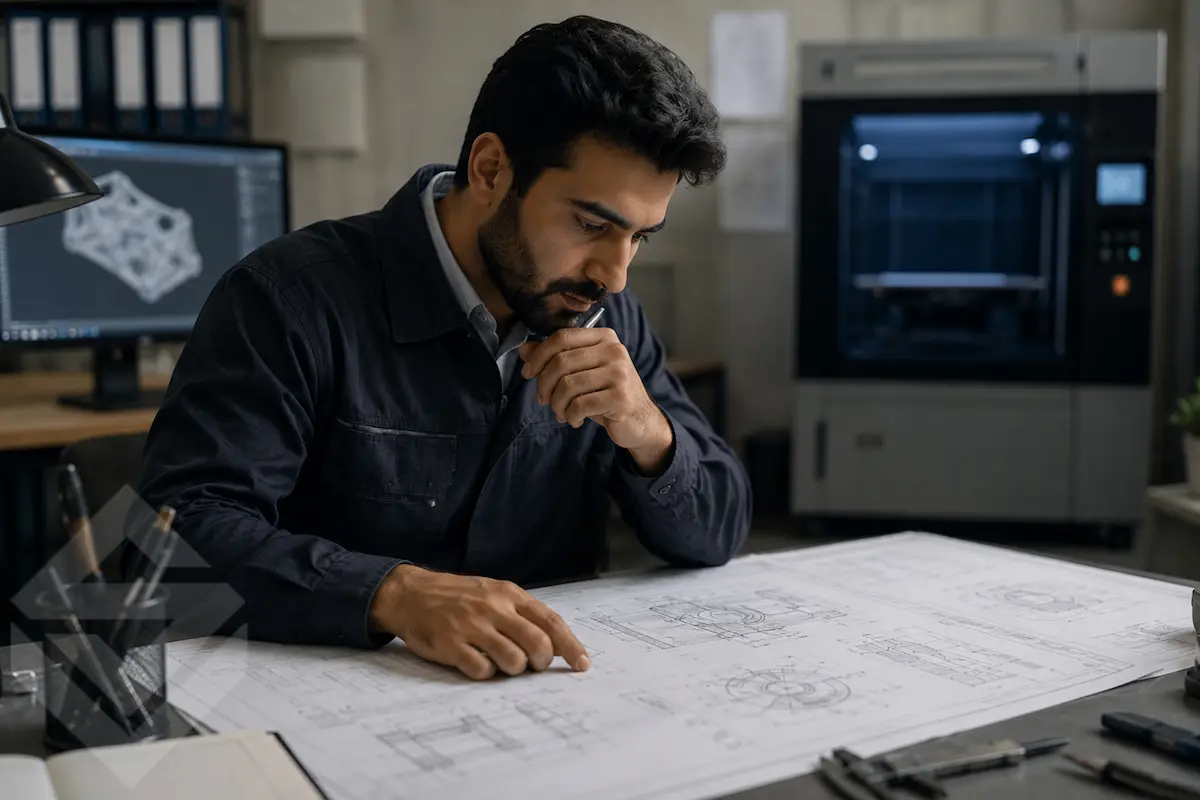
In advanced manufacturing lines and modern industries, an unexpected shutdown caused by the failure or breakage of a critical component can impose substantial costs on production.
Until a few years ago, replacing such components was only possible through expensive imports or conventional manufacturing methods such as CNC machining and mold making. These approaches are often neither cost-effective nor time-efficient for low-volume production, obsolete components, or parts with highly complex geometries.
Today, however, the advancement of additive manufacturing has transformed traditional production methods. Metal 3D printing services have emerged as a revolutionary solution, enabling engineers, designers, and production managers to manufacture highly complex metal components with exceptional strength and precision without the need for costly tooling or molds.
Nevertheless, successfully manufacturing industrial parts using this technology requires a thorough understanding of material selection, design optimization, and the ordering process.
If you are looking for a clear guide on evaluating your part, selecting the right material, and estimating production costs, this article will walk you through every step of the process.
How Do You Know If You Need Metal 3D Printing Services?
One of the first questions every production manager or engineer asks is whether a component should be manufactured using metal additive manufacturing or whether conventional methods such as CNC machining or casting are more suitable.
The answer is simple: evaluate your part using the following five-point checklist.
If your component meets at least two of the criteria below, metal 3D printing is likely the fastest, most cost-effective, and technically appropriate manufacturing solution.
Complex Geometry and Internal Structures
Your component includes intricate cooling channels, hollow sections, lattice structures, or complex geometries that are difficult or impossible to produce using conventional CNC machining.
High-Performance or Difficult-to-Machine Alloys
The part must be manufactured from advanced materials such as Inconel, Titanium, or other superalloys, where traditional machining results in excessive tool wear, long machining times, and high production costs.
Obsolete, Unavailable, or Broken Components Without a 3D Model
The component belongs to imported or legacy equipment, replacement parts are unavailable in the market, and sourcing them through import could halt production for weeks or even months.
Lightweight Design Requirements
The component must maintain maximum mechanical strength while significantly reducing weight through topology optimization or internal lattice structures capabilities uniquely enabled by metal additive manufacturing.
Low-Volume Production or Rapid Prototyping
Only a limited number of parts are required, making the cost of producing dedicated molds or tooling economically unjustifiable. Metal 3D printing enables fast, tooling-free production with significantly shorter lead times.
From a Damaged Part to a Production-Ready Model: How Does the Manufacturing Process Begin?
Once you have determined that your component is a suitable candidate for metal 3D printing, the next question is: How do you transform a physical part or an idea into a production-ready digital model?
One of the most common challenges faced by manufacturers is that the original industrial component has become damaged, worn, or broken, while no engineering drawings or CAD files are available.
Depending on your situation, the preparation process follows one of the two workflows below.
Scenario 1: You Do Not Have a 3D CAD Model
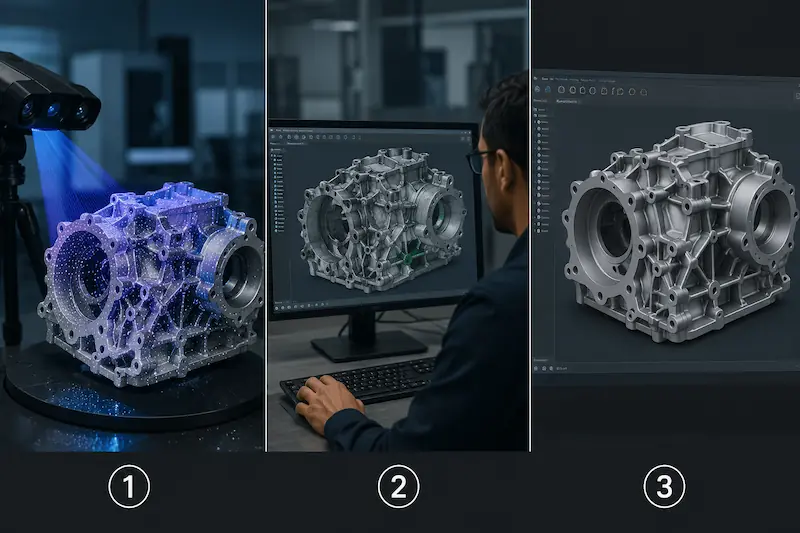
If you only have a physical component even if it is broken, worn, or incomplete the process typically consists of the following steps:
- 3D Scanning : The component is scanned using high-precision optical or laser scanners to capture its geometry and generate an initial point cloud with micron-level accuracy.
- Reverse Engineering of Industrial Components : Specialized reverse engineering engineers reconstruct the damaged, deformed, or worn sections using advanced CAD software, restoring the original geometry and functionality of the part.
- Creation of a Production-Ready CAD Model : Once the reconstruction is complete, a precise 3D CAD model is generated, ready for metal additive manufacturing.
Scenario 2: You Already Have a 3D CAD Model
If your engineering team has already designed the component, you should verify the following before submitting the file for metal 3D printing:
- Export the Model in Standard Engineering Formats : Use widely accepted industrial file formats such as STEP (.step/.stp) or IGES (.igs/.iges) whenever possible. While STL files are suitable for preliminary evaluation, STEP files preserve engineering data and are preferred for manufacturability analysis and any required post-processing or machining.
- Check Wall Thickness and Unsupported Features : Extremely thin walls (typically below 0.5 mm) and unsupported overhangs or steep angles may deform during the printing process. Reviewing these features in advance helps ensure successful fabrication.
Key Takeaway:
Companies that provide metal 3D printing services typically perform a comprehensive manufacturability analysis before production begins. If necessary, they optimize the design to improve printability, reduce manufacturing risks, and ensure the highest possible quality of the final component.
Which Metal Is Suitable for Your Application? Material Selection for Manufacturing Industrial Components
After preparing the 3D model, the next critical step is selecting the appropriate material and alloy. Choosing the wrong material can lead to component failure under industrial operating conditions or impose unnecessary production costs.
A wide variety of engineering alloys are used in the metal 3D printing process. To help you determine which option is best suited to your application, consider the following guide:
1. Components Subjected to High Pressure and Wear (Tool Steels and Stainless Steels)
- Common Alloys: Stainless Steel 316L and Tool Steel
- Characteristics: High corrosion resistance, excellent tensile strength, and good machinability and heat-treatment capability.
- Industrial Applications: Plastic injection molds, die-casting molds, pump components, industrial valves, and wear-resistant tooling.
2. Lightweight Components with High Thermal Conductivity (Aluminum Alloys)
- Common Alloys: Aluminum-Silicon Alloys (AlSi)
- Characteristics: Very low weight, high thermal conductivity, and an excellent strength-to-weight ratio.
- Industrial Applications: Heat exchanger components, engine housings, automotive parts, and lightweight aerospace components.
3. Components Operating at High Temperatures or in Chemical Environments (Inconel Superalloys)
- Common Alloys: Inconel 718 and Inconel 625
- Characteristics: Exceptional resistance to extremely high temperatures, oxidation, and acidic corrosion.
- Industrial Applications: Turbine components, fuel nozzles, and equipment used in the oil, gas, and petrochemical industries.
4. High-Performance Components Requiring an Excellent Strength-to-Weight Ratio (Titanium Alloys)
- Common Alloys: Titanium Grade 5 (Ti-6Al-4V)
- Characteristics: Exceptional mechanical strength, low weight, excellent corrosion resistance, and biocompatibility.
- Industrial Applications: Critical aerospace and defense components, custom medical implants, and high-performance motorsport equipment.
For more information, we recommend reading our article, "What Is Metal 3D Printing? A Comprehensive Guide to the Technology and Its Applications."
Quick Material Comparison Table for Industrial Part Manufacturing
| Alloy | Key Characteristic | Best Industrial Applications |
|---|---|---|
| Stainless Steel & Tool Steel | High corrosion and wear resistance | Mold making, general industrial components, and valves |
| Aluminum Alloys | Lightweight with high thermal conductivity | Heat exchangers and lightweight structural components |
| Inconel Superalloys | Exceptional resistance to high temperatures and pressure | Turbines, oil & gas, and petrochemical industries |
| Titanium Alloys | Outstanding strength-to-weight ratio | Aerospace, specialized equipment, and medical applications |
Tip: If you are unsure which alloy is best suited to your application, share your component's operating conditions such as temperature, pressure, the working fluid it comes into contact with, and expected wear with our engineering team. We will recommend the most suitable material for your specific manufacturing requirements.
Do You Own a Metal 3D Printer?
Up to this point, we have covered every stage of the metal 3D printing service workflow from evaluating your component and preparing the CAD model to selecting the appropriate material for manufacturing.
However, if your company already operates a metal 3D printer and you are experiencing technical issues or unexpected machine downtime during production, this section provides a brief guide to troubleshooting and repair.
If you are looking to outsource the manufacturing of your component instead, you can skip ahead to the next section, which explains the ordering process and component delivery.
Troubleshooting Guide and Repair Services for Metal 3D Printers
Understanding common machine failures helps operators and technical managers determine when a problem can be resolved through simple adjustments and when professional repair services are required.
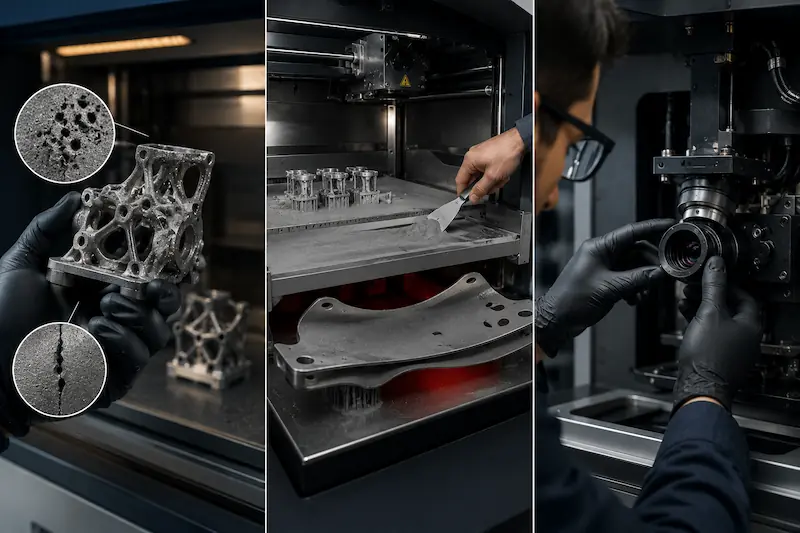
- Poor Print Quality and Porosity: The appearance of pores or fine cracks in the printed part, usually caused by incorrect laser power calibration, excessive moisture in the metal powder, or instability in the shielding gas flow.
- Uneven Layers and Warping: Typically caused by improper build platform temperature settings, excessive thermal stresses, or malfunctions in the powder delivery system.
- Optical System Misalignment: Reduced dimensional accuracy due to misaligned focusing lenses or laser scanning optics.
When Should You Troubleshoot It Yourself, and When Should You Call a Specialist?
- Stop the Machine: As soon as you notice a quality issue, pause the printing process to prevent unnecessary material waste and production delays.
- Perform Basic Operator Checks: Start with routine inspections such as cleaning the optical lenses, checking the moisture level of the metal powder, and performing software calibration.
- Shut Down the System and Contact a Service Engineer: If the problem involves the laser source, electronic control boards, or motion systems, discontinue operation immediately and leave further diagnostics and repairs to qualified specialists to avoid costly damage.
Preventive Maintenance to Avoid Metal Part Defects
- Store Metal Powder Under Proper Conditions: Always keep metal powders in a cool, dry environment, as moisture is one of the primary causes of poor print quality.
- Clean the Optical System Regularly: Clean protective lenses and galvanometer mirrors according to the manufacturer's maintenance guidelines.
- Replace Filters on Time: Replace the shielding gas circulation filters before they become fully saturated to maintain stable process conditions.
- Lubricate and Calibrate Motion Axes: Regularly lubricate and calibrate the linear motion systems and powder recoater mechanism to ensure consistent printing performance.
From Order Placement to Part Delivery: Manufacturing and Final Preparation Process
Whether you plan to outsource your metal 3D printing project to a specialized service provider or carry out the reverse engineering of industrial components within your own organization, every project follows a structured engineering workflow to ensure a precise, production-ready part.
- Technical File Review and Manufacturability Assessment: After submitting the 3D model, the part is evaluated for manufacturability. During this stage, engineers analyze and optimize overhangs, support structure requirements, wall thicknesses, and the optimal build orientation for the printing process.
- Cost Estimation and Manufacturing Method Selection: A detailed quotation is prepared based on material volume, laser operating time, and alloy selection. Unlike conventional powder bed fusion technologies, which are primarily used to manufacture new components from scratch, advanced processes such as Direct Energy Deposition (DED) can also repair, rebuild, and clad worn or damaged components in addition to producing large-scale new parts. This capability can significantly reduce overall project costs.
- Metal Printing and Layer Deposition: Once the project is approved, the metal powder is melted layer by layer under a controlled shielding gas atmosphere using a high-power laser, producing a dense, high-strength component. Thanks to its high deposition rate, DED technology significantly shortens the production time for large metal parts.
- Post-Processing: The Key to Final Quality: Metal 3D printing is only one step in the manufacturing process. To ensure the component is ready for industrial use, it typically undergoes stress-relief heat treatment, support structure removal, precision CNC machining of critical surfaces, and final polishing.
Practical Tip: Before placing your order, specify whether your component requires precision CNC machining or heat treatment. Including these requirements in the initial quotation ensures a more accurate cost estimate and production schedule.
How Is the Cost of Metal 3D Printing Calculated?
After understanding the manufacturing and post-processing stages, one of the most common questions is how the final production cost is determined.
Unlike traditional manufacturing methods such as CNC machining or casting, where pricing is often based primarily on the raw material weight, metal 3D printing services are priced according to several engineering and production factors.
The main factors that determine the cost of metal 3D printing include:
- Material Volume and Weight: The amount of metal powder required determines the base material cost.
- Machine Operating Time: Taller components or parts requiring finer layer deposition increase laser operating time, resulting in higher machine costs.
- Selected Alloy: Different metal powders have different prices. For example, 316L stainless steel is generally more economical, while superalloys such as Inconel and Titanium are considerably more expensive.
- Deposition Technology: High-deposition-rate technologies such as Direct Energy Deposition significantly reduce the printing time for large metal components, making the manufacturing process more cost-effective.
- Post-Processing Requirements: Additional operations including stress-relief heat treatment, part removal from the build platform, precision CNC machining, and surface polishing have a direct impact on the final production cost.
Cost Comparison of Metal 3D Printing Based on Material and DED Manufacturing Capabilities
| Alloy | Material Cost Level | Deposition Speed (DED) | Post-Processing & Machining Requirements |
|---|---|---|---|
| 316L Stainless Steel | Economical and cost-effective | Very High | Turning or CNC machining of mating surfaces |
| Aluminum and Its Alloys | Moderate | High | Moderate |
| Inconel & Superalloys | High | Significantly reduces production time | Heat treatment and precision CNC machining |
| Titanium | Very High | Requires precise shielding gas control | High |
Practical Tip: If your goal is to reduce manufacturing costs for large industrial components, choosing high-deposition-rate technologies such as Direct Energy Deposition (DED) or optimizing the design to reduce material consumption will provide the greatest cost savings.
Metal 3D Printed Part Delivery Checklist | How to Evaluate the Quality of the Service
When you receive your order from a metal 3D printing service provider, use the following three-step checklist to verify the quality and technical accuracy of the finished component.
1. Verify Structural Integrity and Part Density
- Visual Inspection: Examine the component under adequate lighting to ensure there are no hairline cracks or defects caused by thermal stresses.
- Internal Density: Metal 3D printed parts should typically achieve a density greater than 99%. For critical applications, internal quality can be verified using non-destructive testing methods such as ultrasonic inspection.
2. Check Dimensional Accuracy of Critical Features and Threads
- Dimensional Inspection: Measure the key dimensions using a digital caliper or a Coordinate Measuring Machine (CMM) and compare the results with the engineering drawing or the CAD model generated through the reverse engineering process.
- Inspect Mating Surfaces: Verify bearing seats, threaded holes, and all CNC-machined surfaces to ensure they meet the specified dimensional tolerances.
3. Evaluate Mechanical Properties and Surface Finish
- Surface Roughness Inspection: Ensure the surface finish obtained after sandblasting or polishing meets the requirements of your intended application.
- Mechanical and Metallurgical Verification: For critical industrial projects, the service provider should supply a quality control report along with hardness test certificates and, where applicable, documentation related to the metal powder used during manufacturing.
Professional Metal 3D Printing Services with DED Technology at Namavaran Sanat Vandad
Choosing a reliable partner for manufacturing critical industrial components has a direct impact on the final product quality, production efficiency, and overall manufacturing costs.
Namavaran Sanat Vandad, a knowledge-based company and one of the pioneers of metal 3D printing in Iran, provides advanced Direct Energy Deposition technology along with the engineering expertise required to deliver high-quality metal additive manufacturing services.
Our specialization in DED technology enables manufacturers not only to produce large-scale metal components from scratch but also to repair, rebuild, and clad worn, high-value, or difficult-to-source parts while maintaining exceptional structural integrity and material density.
Why Consult with Namavaran Sanat Vandad's Engineering Team?
- Free Project Feasibility Assessment: Technical evaluation of your CAD model or physical component to determine its suitability for manufacturing using DED technology.
- Significant Cost Reduction: Recommendation of the most efficient deposition strategy and the optimal material to minimize production time and manufacturing costs.
- Comprehensive Engineering Support: End-to-end services covering 3D scanning, reverse engineering, CAD modeling, metal 3D printing, and precision CNC post-processing.
Need Expert Consultation or a Cost Estimate?
If you need technical guidance for the manufacturing or repair of your industrial components, simply share your part specifications and operating conditions with our engineering team. We will evaluate your requirements and recommend the most suitable engineering solution for your application.
Conclusion: The Next Step in Upgrading and Restoring Your Production Line
Additive manufacturing technologies have fundamentally transformed the way industrial components are produced. Today, there is no longer a need to keep production lines idle for months while waiting for a rare replacement part or to invest heavily in dedicated tooling for complex, low-volume components.
As discussed throughout this guide, every stage from design feasibility analysis and material selection to metal printing and post-processing is focused on reducing production costs, shortening lead times, and improving manufacturing efficiency.
If you are looking for a fast and cost-effective solution for manufacturing or restoring worn, obsolete, or geometrically complex components, metal 3D printing services powered by advanced technologies such as DED enable the production of large-scale parts as well as the repair of damaged equipment at a significantly lower cost than conventional manufacturing methods.
3-Step Checklist to Start Your Project
- Evaluate Your Requirements: Assess your component based on its geometric complexity, alloy requirements, and production volume.
- Prepare the CAD Model: If you do not have an engineering drawing or 3D model, use industrial reverse engineering services to generate a production-ready CAD file.
- Request a Consultation and Quotation: Submit your metal 3D printing inquiry and share your component's operating conditions with our technical specialists to receive an accurate estimate of production time and cost.
Our engineering team is ready to review your technical files, recommend the most appropriate deposition strategy, and support you throughout every stage of the metal 3D printing process. Contact us today to receive expert consultation and request a quotation.
Frequently Asked Questions
How strong are metal 3D printed parts?
Metal 3D printed components typically achieve a density of over 99%. After appropriate heat treatment, their mechanical strength and metallurgical properties are comparable to or in some cases even exceed those of parts manufactured using conventional methods such as casting.
Is it possible to manufacture a part from a damaged or broken sample?
Yes. By combining 3D scanning with industrial reverse engineering services, a damaged or worn component can be digitally reconstructed into an accurate 3D CAD model, which is then prepared for metal 3D printing.
Can large industrial components be manufactured using metal 3D printing?
Yes. High-deposition-rate technologies such as Direct Energy Deposition enable the production of large industrial components as well as the repair and restoration of worn parts in a cost-effective manner.
Can a metal 3D printed part be used immediately after printing?
For general-purpose components, yes. However, if the part includes critical features such as threaded holes, bearing seats, or precision mating surfaces, these areas typically require post-processing with precision CNC machining to achieve the specified dimensional tolerances.
Is there a minimum order quantity?
No. There is no minimum order quantity. One of the key advantages of metal 3D printing is the ability to manufacture even a single prototype or replacement part economically, without the need for expensive tooling or molds.
Some sources:
نظرات
0 نظر
دیدگاهی ثبت نشده.