



As one of the most advanced tools in additive manufacturing, the metal 3D printer has sparked a fundamental revolution in modern metallurgy and heavy industries. This groundbreaking technology leverages advanced metal 3D printing techniques to fabricate highly complex industrial components with maximum precision and minimum material waste.
For decades, industrial designers and materials engineers have faced a monumental challenge: manufacturing components with highly complex geometries whose production via traditional subtractive methods such as casting or CNC machining and turning is either physically impossible or prohibitively expensive. In response to this challenge, various types of metal 3D printers have entered the arena to shift manufacturing paradigms and redefine the boundaries of what is possible in heavy industries.
In this article, we analyze this technology from both scientific and practical perspectives, providing an expert review of its operation, core technological methods, printable alloys, and the criteria for selecting the absolute best solution for your industrial projects.
What is a Metal 3D Printer and How Does It Work?
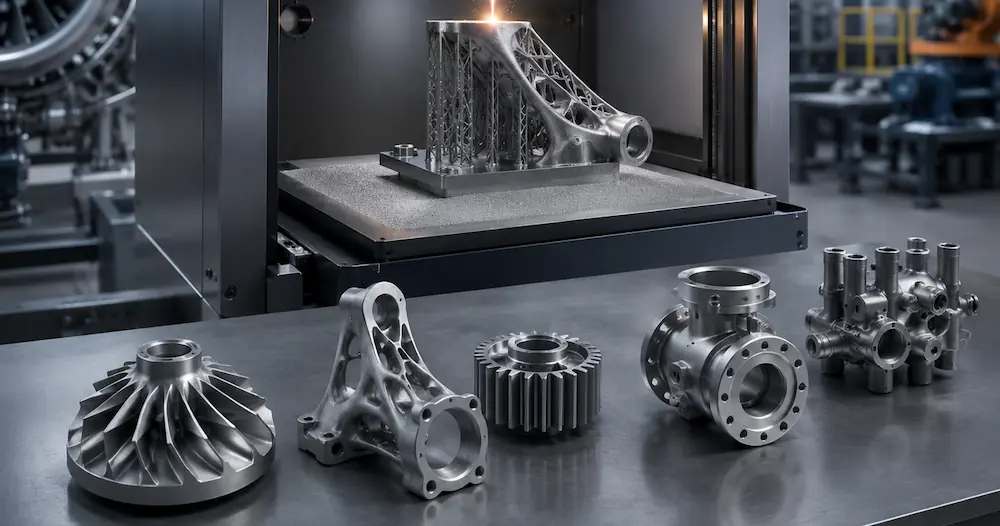
In its simplest definition, a metal 3D printer is an industrial machine that, instead of using traditional manufacturing methods, utilizes a high-energy thermal source such as a laser or an electric arc to melt metal powder or wire, building components layer by layer directly from a 3D digital CAD model.
Unlike traditional subtractive methods like turning or milling, where a large block of metal is shaved down, creating massive material waste to reach the final part, metal 3D printing is an additive process. This means the component is built entirely from scratch, layer by micron-level layer, adding material only where it is mathematically required.
The Strategic Importance of Metal 3D Printing in Industry
The introduction of metal additive manufacturing to the production ecosystem was not merely the launch of a new machine; it represents a comprehensive paradigm shift in manufacturing engineering. Global and strategic industries have turned to metal 3D printers because this technology solves critical engineering challenges for which no prior solutions existed. The primary drivers behind the importance of this technology include:
1. Limitless Design Freedom and Topology Optimization
In traditional methods, the designer is constantly constrained by the physical limitations of CNC cutting tools or the extraction angles of casting molds. Metal 3D printing completely eliminates these design boundaries. Engineers can now design and manufacture components with complex conformal internal cooling channels such as gas turbine blades with curved cooling paths or intricate lattice structures that are simultaneously lighter and significantly stronger than their traditional counterparts.
2. Drastic Waste Reduction of Expensive Raw Materials
In industries such as aerospace and power generation, which rely on highly expensive superalloys like titanium, Inconel, and cobalt-chrome, the buy-to-fly ratio (the weight ratio of raw material to the final component) is critically important. In traditional machining, up to 90% of a premium alloy block is often carved away into useless scrap chips. Conversely, a metal 3D printer builds the component directly to its near-net shape, reducing material waste to near zero.
3. Supply Chain Compression and Moldless Production
To manufacture a metal part via traditional casting, an incredibly time-consuming and expensive mold design and tooling process must be executed first, which is completely uneconomical for single-unit prototypes or low-volume production runs. Metal 3D printing eliminates the need for molds, fixtures, or intermediary tooling. You can send the digital CAD file directly to the machine and receive the finished part within days, compressing product development lead times by up to 80%.
4. Advanced Repair and Retrofitting of Worn, High Value Components
One of the greatest operational pain points in the oil, gas, and power generation industries is the wear and thermal degradation of massive, expensive rotating machinery components. Fully replacing these components is extraordinarily expensive and often logistically impossible due to supply chain restrictions. Specific metal 3D printing technologies, such as Directed Energy Deposition, allow engineers to deposit new layers of high-performance alloys directly onto the damaged or corroded zones of an existing asset, fully rebuilding it and returning it to active service at a fraction of the cost.
Summary: By seamlessly combining three core factors component weight reduction, minimal material waste, and the elimination of upfront tooling costs the metal 3D printer transforms manufacturing from an expensive operational bottleneck into a powerful competitive advantage.
Technical Analysis of Core Metal 3D Printing Technologies
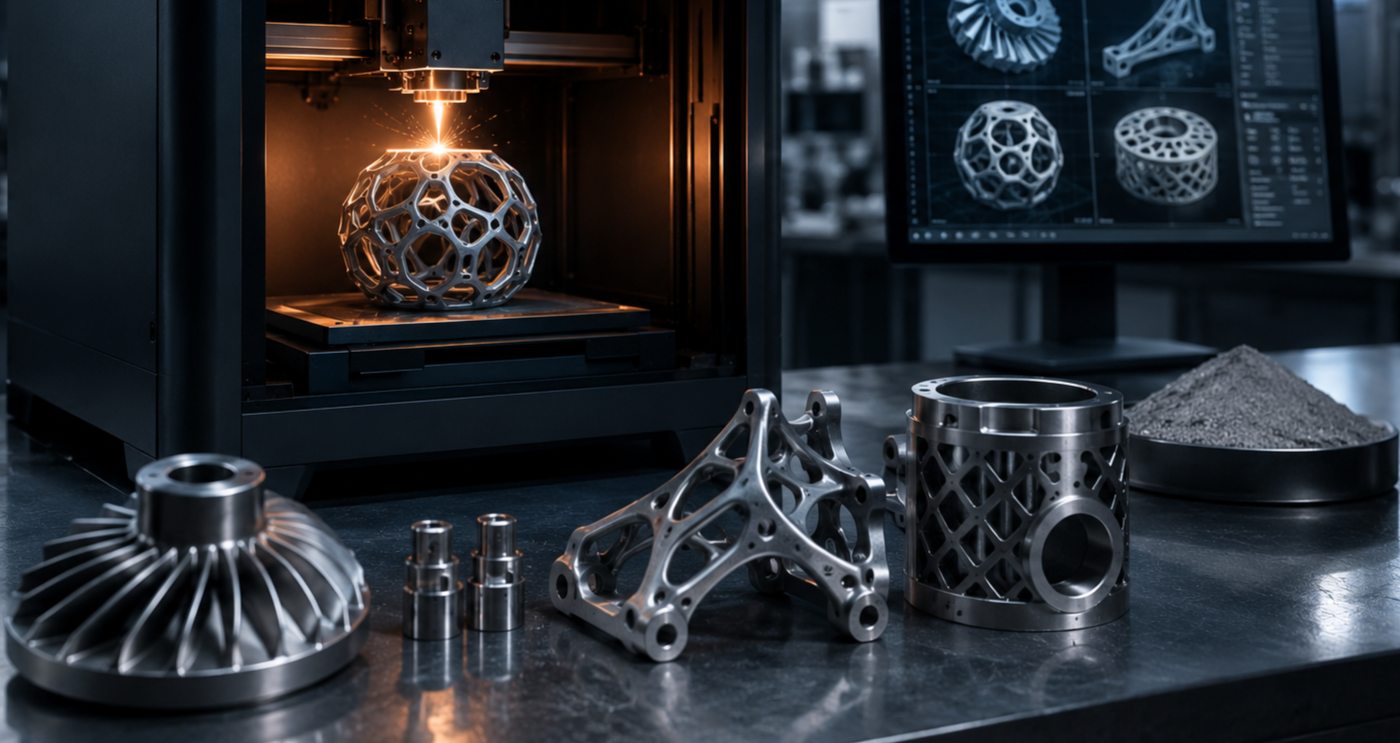
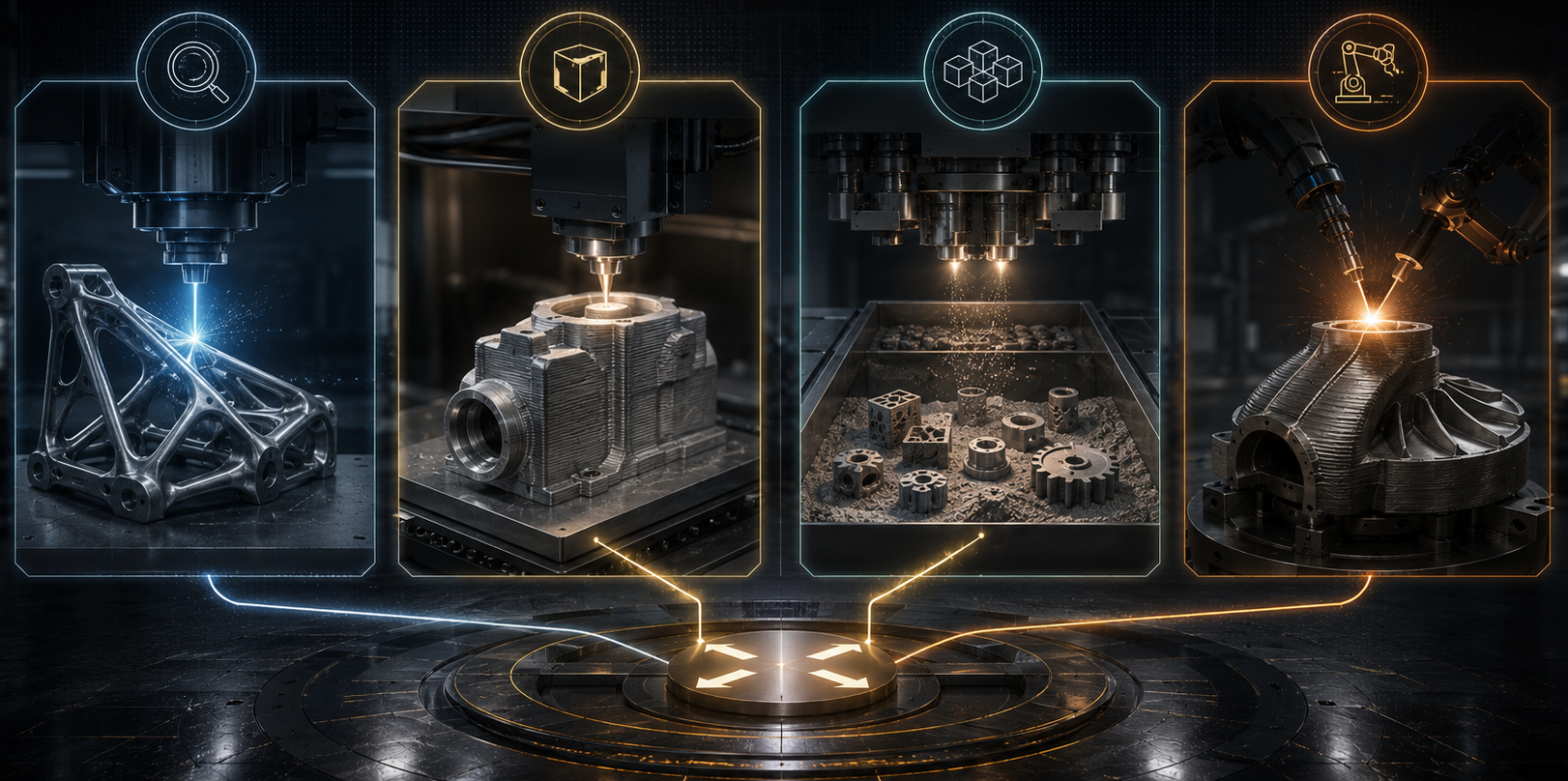
Metal additive manufacturing processes are categorized into four primary technologies based on their feedstock delivery mechanism and their thermal energy source. Understanding these differences is the key to selecting the right method for any industrial project:
1. Powder Bed Fusion
Commonly known in the market by terms such as Selective Laser Melting or Electron Beam Melting, this approach is the most established path for achieving miniature, intricate components. In this technology, a concentrated energy beam (laser or electron beam) selectively melts microscopic particles on an ultra-thin metal powder bed, bonding them layer by layer. The output of this method yields components with the highest level of structural resolution, exceptionally tight dimensional tolerances, and complex internal channels. However, the build volume is usually limited to small components under 50 centimeters.
2. Directed Energy Deposition
In stark contrast to the previous method, this technology is engineered for large-scale industrial applications and highly specialized component repairs. In this method, the machine nozzle mounted onto a robotic arm or a multi-axis CNC motion system simultaneously guides the feedstock material (either alloy wire or metal powder) and the thermal energy source (laser or electric arc) to the target focus point, melting and depositing the material the fraction of a second it exits the nozzle. The greatest advantages of this technology are its exceptionally high deposition rates, massive build volumes, and its unique ability to print directly onto existing components, giving engineers complete freedom to repair, upgrade, and thermally clad heavy industrial machinery.
3. Binder Jetting
This method can be described as a shaping process that operates entirely without direct thermal application during the printing phase, aiming primarily for high-speed throughput and mid-to-high volume production. It operates in a two-stage cycle: first, an industrial inkjet head selectively deposits a liquid bonding agent (binder) onto a metal powder bed to define the layer geometry, forming a delicate, porous structure known as a "green part." Second, this green part is extracted and transferred to a controlled-atmosphere sintering furnace, where the binder is burned off and the metal particles bond near their melting point to reach full density and final mechanical properties. Eliminating lasers from the print phase drastically accelerates production speeds and lowers the cost of complex small-to-medium parts.
4. Material Extrusion
Sharing close mechanical similarities with standard polymer FDM printers, this technology represents the most cost-effective and safe solution for design offices and workshop environments. The raw feedstock is supplied as composite filaments or rods containing a high percentage of pure metal powder bound within a polymer/wax matrix. The material passes through a heated nozzle to build the raw shape of the part. The printed part then undergoes a chemical or thermal debinding process to remove the polymer matrix, followed by a final sintering furnace run to achieve metallurgical purity, density, and industrial-grade strength at a minimal investment cost.
Comparative Matrix: Technical Specifications and Industrial Applications
| Key Selection Factors | Powder Bed Fusion | Directed Energy Deposition | Binder Jetting | Material Extrusion |
|---|---|---|---|---|
| Dimensional Accuracy & Surface Finish | Exceptionally High (Minimal post-processing required) | Moderate (Typically requires final CNC machining) | Moderate to High (Undergoes predictable shrinkage in furnace) | Moderate (Post-machining required for precision fits) |
| Production Speed (Deposition Rate) | Low and time-intensive | Extremely High and fast | Ultra-Fast (Ideal for higher volumes) | Moderate to Low |
| Maximum Build Volume | Restricted (Usually under 50 cm) | Virtually Unlimited (Dependent on robotic arm/CNC workspace) | Moderate (Limited to the machine build envelope) | Small (Suited for compact workshop scales) |
| Component Repair & Remanufacturing | Impossible (Builds from scratch only) | Excellent (The specialized industry standard for cladding) | Impossible | Impossible |
| Initial Capital Investment | Prohibitively Expensive | High (Yields rapid ROI in heavy industrial sectors) | Relatively High | Economical and highly affordable |
| Primary Industrial Application | Intricate medical implants, aerospace manifolds, lab components | Mold repair, rotating equipment in oil/gas, power plants | Mass production of non-critical, complex small parts | Functional engineering prototypes, temporary manufacturing jigs |
Pros and Cons of Metal 3D Printing: Opportunities and Engineering Challenges
While metal 3D printing unlocks unparalleled advantages for modern production lines, no engineering solution is devoid of limitations. To make an informed strategic decision, the pros and cons of this additive manufacturing tool must be evaluated objectively:
Strategic Advantages of Metal 3D Printers
- Fabrication of Impossible Geometries: Enables the production of components featuring curved internal cooling channels and extreme topology optimization that are physically impossible to execute via traditional casting or standard CNC milling.
- Drastic Reduction in Raw Material Costs: Unlike subtractive processes that turn premium material blocks into waste chips, expensive materials like titanium and superalloys are utilized precisely to match the exact volume of the CAD design.
- Rapid Prototyping and Tooling Elimination: Removes the lengthy and high-cost bottlenecks of traditional mold-making; digital files are sent straight to execution, delivering functional end-use parts in a fraction of the time.
- Advanced Industrial Customization: Offers absolute flexibility to produce single-unit, customized components ranging from patient-specific orthopedic implants to distinct replacement parts for heavy machinery.
Technical Limitations and Challenges
- High Initial Capital and Material Costs: The baseline market price for industrial systems and specialized metal powders remains high (though this raw material cost barrier is drastically lowered in advanced wire-fed systems).
- Mandatory Post-Processing Operations: Upon print completion, components almost always require secondary steps such as post-weld heat treatment in furnaces to relieve residual thermal stresses, or precision CNC machining to achieve exact surface finishes and tight tolerances.
- Inefficiency in Mass-Production: While it reigns supreme for complex, strategic, and low-to-medium batch runs, it remains uncompetitive against traditional manufacturing for producing millions of geometrically simple parts.
- Powder Handling Safety Risks: Operating with loose, microscopic metal powders demands specialized air filtration, respiratory protection, and strict safety guidelines to manage inhalation or combustible dust risks (a hazard completely bypassed by wire-fed alternative technologies).
Which Technology Creates the Highest Value for Your Needs?
- A rigorous analysis of additive manufacturing demonstrates that no single technology serves as a universal solution for all industrial demands. Each method was developed to address specific challenges, and correct selection depends entirely on part dimensions, required tolerances, batch volumes, material costs, and operational environments:
- If your priority is "Structural Intricacy and Micron-Level Precision" (Powder Bed Fusion): This method delivers unmatched performance for parts with highly detailed geometries, fine tolerances, and premium surface finishes, such as medical implants or critical aerospace components.
- If your priority is "Rapid and Economical Bench-Top Prototyping" (Material Extrusion): This method provides an affordable, accessible solution for fabricating initial functional mockups, verifying form fits, and analyzing designs before committing to final mass manufacturing.
- If your priority is "High-Speed, Mid-Volume Batch Production" (Binder Jetting): By decoupling the printing phase from thermal application, this technology offers rapid layer deposition rates, making it highly effective for batches of complex small-to-medium parts.
- If your priority is "Reducing Maintenance Costs, Repairing Assets, and Building Large-Scale Parts" (Directed Energy Deposition): In heavy industries such as oil, gas, petrochemicals, power plants, and steel mills, unexpected downtime and spare part sourcing are massive financial liabilities. Directed Energy Deposition addresses this by enabling large-scale fabrication, the automated rebuilding of worn surfaces, and localized metallurgical cladding to maximize asset lifespans.
Note
In the newest generation of industrial Directed Energy Deposition systems, capabilities extend far beyond basic material deposition. Modern industrial platforms integrate additive manufacturing directly with multi-axis CNC milling, allowing additive deposition and subtractive finishing to occur in a single, continuous setup. This hybrid approach drastically boosts dimensional accuracy while cutting out the time, labor, and logistically intense costs of moving heavy components across multiple machines.
Today, through the successful domestic development of these advanced hybrid industrial platforms by the knowledge-based company namavaran sanat vandad, heavy industries can now perform localized additive deposition, precision CNC milling, and complex component remediation under a single unified platform with maximum metallurgical quality completely independent of volatile foreign supply chains.
Which Alloys are Compatible with Metal 3D Printers?
Industrial sectors select specialized, highly standardized alloys for metal 3D printing based on their mechanical load, chemical exposure, and thermal threshold requirements. The primary engineering materials utilized include:
- Tool and Carbon Steels: The baseline materials for manufacturing heavy-duty industrial molds, stamping dies, workshop tooling, and high-load power transmission shafts.
- Stainless Steels (e.g., SS316L): Highly utilized across the oil, gas, petrochemical, and marine industries due to its premium resistance to aggressive chemical corrosion and acid exposure.
- Superalloys (e.g., Inconel): High-cost, nickel-based alloys engineered to withstand extreme thermal conditions and high mechanical stress, primarily used in power plant gas turbine blades and aerospace exhaust systems.
- Lightweight Alloys (Titanium and Aluminum): Strategic materials for the aerospace, automotive, and medical implant fields due to their superior strength-to-weight ratios and biocompatibility.
Technical and Economic Insight: The industrial platforms developed by namavaran sanat vandad feature highly flexible, advanced wire-feed systems and precise thermal source control, making them completely compatible with widely available, standard commercial alloy wires (including various steel grades, stainless steel, and aluminum). This engineering advantage entirely bypasses the high costs, storage hazards, and importing complexities associated with foreign metallurgical powders, lowering operational barriers for domestic heavy industries.
Conclusion
Metal 3D printers are no longer a distant laboratory concept; they are actively reshaping modern production lines, maintenance protocols, and supply chain logistics globally and domestically. While choosing the right system from among Powder Bed Fusion, Directed Energy Deposition, Binder Jetting, and Material Extrusion requires a thorough evaluation of dimensional, metallurgical, and economic variables, an accurate understanding of each system's strengths prevents misallocated capital. The localized engineering of integrated hybrid industrial platforms by leading knowledge-based firms like namavaran sanat vandad has paved a reliable path for heavy industries to deploy this advanced technology, maximizing structural performance while driving down operational costs.
faq
1. Are metal 3D printed components as strong as traditionally machined parts?
Yes; when utilizing the correct alloy specs coupled with appropriate post-print heat treatment (furnace cycles), the density and mechanical properties meet or exceed standard cast or wrought metal baselines.
2. How much does a commercial metal 3D printer cost?
Pricing scales heavily based on build volume and core technology (powder vs. wire), but wire-fed industrial Directed Energy Deposition systems offer a vastly superior return on investment by utilizing economical commercial wire instead of specialized powders.
3. What is the fundamental difference between powder-based and wire-fed metal 3D printers?
Powder bed methods excel at small, intricate, micro-detailed components, whereas wire-fed technologies are optimized for large-scale parts, high-speed output, and structural asset repair.
4. Can metal 3D printed parts be used immediately right after printing?
No; most components require basic post-processing, such as localized CNC machining to clean critical tolerances or furnace baking to relieve internal thermal stresses.
5. Which industries capture the highest financial value from metal 3D printing?
The oil, gas, petrochemical, power generation, steel manufacturing, aerospace, and heavy tool/mold-making sectors capture the highest value, particularly for heavy asset remediation and manufacturing critical spare parts.
نظرات
0 نظر
دیدگاهی ثبت نشده.