


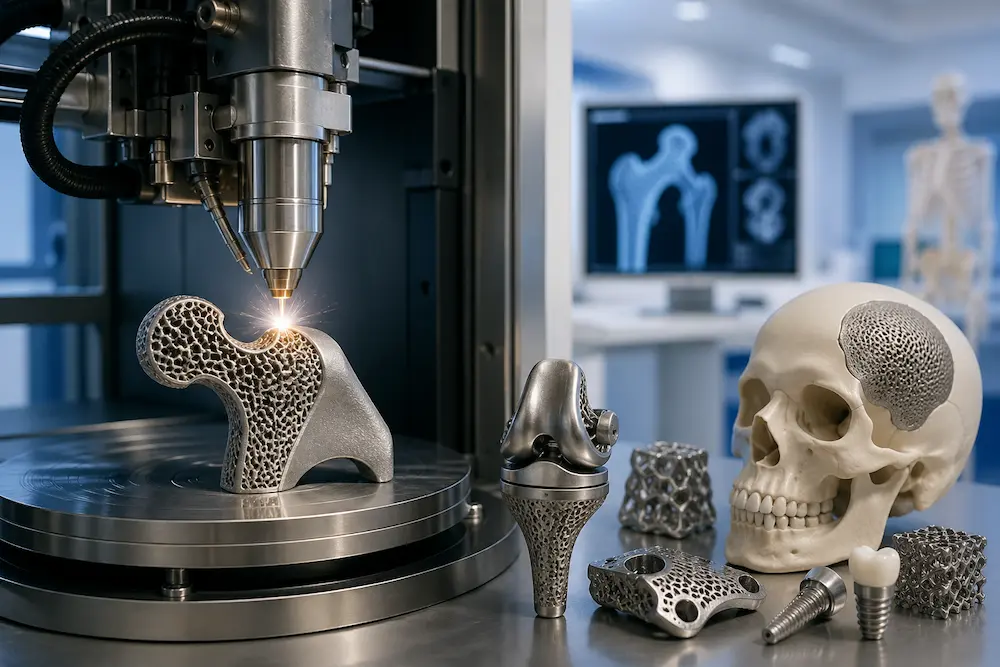
In the fields of medicine and biomedical engineering, precision, speed, and personalization are three critical factors that are directly linked to human life. Traditional manufacturing methods for medical equipment are often time-consuming and cannot fully adapt to the unique anatomy of each patient. This limitation has significantly increased the demand for advanced manufacturing technologies.
In this context, Direct Energy Deposition (DED) and metal 3D printing have introduced a completely new approach to the design and production of medical devices. This technology enables the fabrication of precise, customized, and biocompatible components, playing a key role in improving treatment quality.
At Namavaran Sanat Vandad, we have leveraged this technology to open a new path in the production of medical components and biomedical engineering tools—where accuracy, speed, and patient-specific solutions are the top priorities.
In the following sections, we explore the key applications of this technology in modern medicine and show how it can transform the healthcare process.
Key Features of DED Technology in Medical and Biomedical Engineering
- Full patient-specific customization
Direct Energy Deposition (DED) enables the design and production of medical devices fully adapted to each patient’s anatomy. This improves treatment accuracy and reduces fitting errors. - High precision in complex medical components
This technology allows the creation of highly complex geometries, which are essential for medical tools and implants. The result is improved performance and higher-quality surgical equipment. - Reduced production and delivery time for medical devices
By eliminating molds and traditional manufacturing steps, production time is significantly reduced. This is especially critical in urgent medical situations. - Compatibility with biocompatible materials
Materials such as titanium and medical-grade stainless steel can be used, ensuring high compatibility with the human body and reducing the risk of complications. - Improved treatment quality and surgical outcomes
Higher precision in implant and tool manufacturing leads to better surgical procedures and more stable, successful treatment results. - Rapid response in emergency situations
In urgent cases, medical components can be produced quickly, playing a vital role in decision-making and life-saving treatments. - Reduced dependence on external supply chains
Local production of advanced medical equipment reduces reliance on imports and improves access to critical tools. - Production of custom surgical instruments
Surgical tools can be designed and manufactured based on the specific needs of surgeons or procedures, increasing overall efficiency in medical operations.
Applications in Medical and Biomedical Engineering
Patient-specific implant manufacturing using CT and MRI data
Direct Energy Deposition (DED) enables the design of implants based on precise medical imaging data such as CT scans and MRI. This means each implant is tailored exactly to the patient’s bone and tissue structure, rather than using a standard model. The result is improved fit accuracy, better mechanical performance, and faster post-surgical recovery.
Use of biocompatible alloys such as titanium and stainless steel
This technology allows the use of specialized medical-grade metals such as titanium and stainless steel, which offer both high strength and excellent compatibility with the human body. These materials reduce the risk of corrosion or adverse biological reactions over time. They also support better integration with bone tissue (osseointegration), improving long-term implant stability.
Production of high-precision and complex surgical tools
DED enables the production of surgical instruments with highly complex geometries and very high precision. These tools are often difficult or expensive to manufacture using conventional methods. As a result, they improve surgical accuracy, provide better access to critical anatomical areas, and enhance overall surgical performance.
Reduced preparation time and improved treatment quality
One of the key advantages of this technology is the elimination of long traditional manufacturing workflows such as mold creation. Instead of waiting weeks or months, required components can be produced in a much shorter time. This directly improves treatment speed and quality, especially in sensitive medical cases.
Fast and precise response for trauma and emergency cases
In emergency situations such as accidents or severe injuries, time is critical. DED allows rapid production of implants and medical tools without compromising precision. This capability can play a decisive role in saving lives and reducing long-term complications in trauma patients.
Conclusion
Direct Energy Deposition (DED) has fundamentally changed the way we approach the design and production of medical and biomedical equipment. It enables fully customized, precise, and biocompatible solutions while removing many limitations of traditional manufacturing methods.
With this approach, healthcare can move from a standardized model toward truly patient-specific treatment, where design accuracy is based on real human data—leading to better outcomes and fewer post-surgical complications.
At Namavaran Sanat Vandad, we do not see this technology merely as a production tool; we consider it a critical infrastructure for the future of advanced medicine. Our goal is to actively contribute to the development of medical technology and enable faster, more effective responses to healthcare needs, especially in critical and emergency situations.
Ultimately, DED is not just a manufacturing method for us—it is a bridge between advanced engineering and the future of medicine
Frequently Asked Questions (FAQ)
What is the medical application of DED technology?
Direct Energy Deposition (DED) is used in medicine for producing custom implants, precise surgical tools, and even repairing medical components. It enables more accurate, patient-specific treatment solutions.
Are implants made with this technology safe for the human body?
Yes. Biocompatible materials such as titanium and medical-grade stainless steel are used in the process. These materials are widely used in medical applications and are highly compatible with the human body.
Is it possible to produce patient-specific implants?
Yes. Using CT and MRI data, the exact structure of a patient’s anatomy can be modeled, allowing fully customized implant design and manufacturing tailored to each individual.
How long does it take to produce medical equipment with this technology?
Production time is significantly shorter compared to traditional methods. Since there is no need for molds or long manufacturing cycles, components can be produced much faster.
Is this technology only used for implants?
No. In addition to implants, it is also used for surgical instruments, repair components, and even laboratory samples in biomedical engineering.
Can this technology be used in emergency situations?
Yes. One of the key advantages of DED is the ability to rapidly produce medical parts, which can be critical in emergencies such as accidents or severe trauma cases.
Is the quality comparable to traditional manufacturing methods?
In many cases, the precision and quality are even higher, especially for complex and customized parts. However, depending on the application, some components may require final post-processing.
نظرات
0 نظر
دیدگاهی ثبت نشده.